

The open-concept kitchen has long been celebrated for its ability to create fluid, sociable spaces that connect cooking, dining and living areas. However, as homeowners live with these layouts over time, many discover that the lack of definition can lead to challenges in functionality, privacy and visual organisation. The desire to reintroduce structure without sacrificing the sense of openness has become increasingly common, prompting a search for creative solutions that balance both worlds.
Understanding open-concept in your kitchen
The evolution of open-plan living
Open-concept kitchens emerged as a response to the desire for more inclusive family spaces where cooking no longer isolated one person from the rest of the household. By removing walls between the kitchen, dining room and living area, these designs fostered conversation and connection whilst maximising natural light flow throughout the home.
Common challenges with open layouts
Despite their popularity, open-concept kitchens present several practical concerns that homeowners frequently encounter:
- Noise from kitchen appliances travels throughout the entire living space
- Cooking odours permeate adjacent areas without barriers
- Visual clutter from kitchen mess becomes visible from every angle
- Lack of defined zones creates ambiguity in furniture placement
- Difficulty establishing distinct atmospheres for different activities
Recognising these limitations marks the first step towards creating a more functional and comfortable environment that maintains openness whilst introducing necessary structure. The following strategies offer practical approaches to achieving this balance.
Creating distinct zones with furniture
Strategic furniture placement as spatial dividers
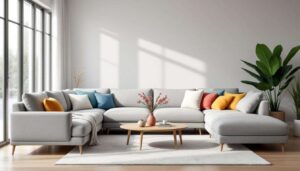
Furniture serves as one of the most versatile tools for defining spaces without permanent construction. A well-positioned sofa can act as a natural boundary between the kitchen and living area, creating an implied separation that maintains sightlines whilst establishing distinct zones. Console tables placed behind seating areas provide additional definition whilst offering practical surface space for lamps and decorative objects.
The role of kitchen islands and peninsulas
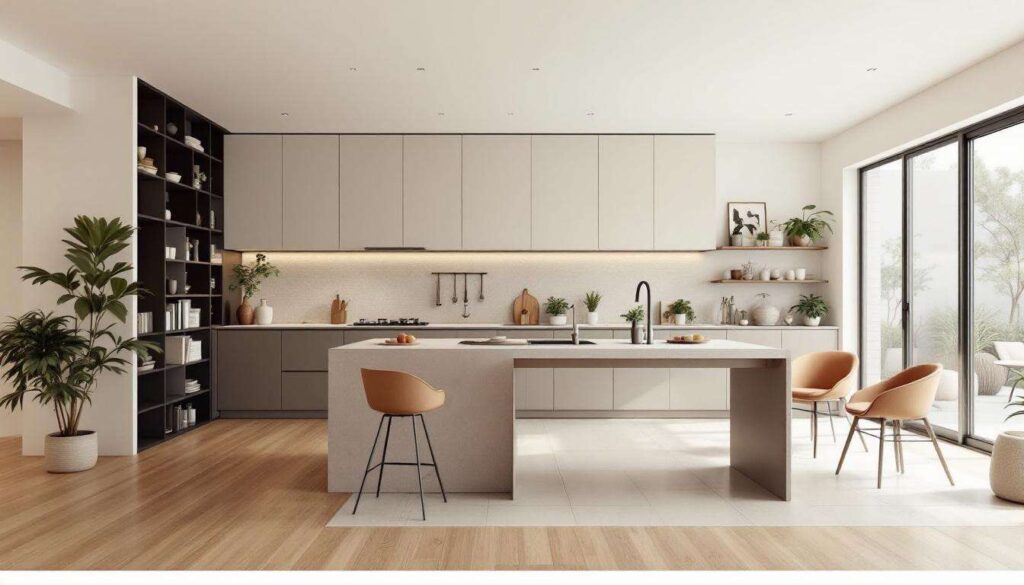
Kitchen islands function as multifunctional anchors that naturally delineate the cooking zone from surrounding areas. When positioned thoughtfully, they create a physical and visual boundary whilst providing additional workspace, storage and seating. Peninsulas offer similar benefits with the added advantage of connecting to existing cabinetry, forming a more pronounced separation between the kitchen and adjacent spaces.
Dining tables as zone markers
The dining table itself becomes a powerful tool for spatial organisation when positioned deliberately. Placing it between the kitchen and living areas creates a transitional buffer zone that separates cooking activities from relaxation spaces. The choice of table shape and orientation further influences how effectively it divides the room whilst maintaining flow between areas.
| Furniture type | Spatial impact | Additional benefits |
|---|---|---|
| Kitchen island | Strong definition | Storage, seating, workspace |
| Sofa placement | Moderate definition | Maintains sightlines, flexible |
| Console table | Subtle definition | Display space, minimal footprint |
| Dining table | Moderate definition | Functional necessity, gathering point |
These furniture-based strategies establish clear zones whilst preserving the essential openness that makes the layout appealing. Beyond physical arrangement, lighting plays an equally crucial role in defining these newly created areas.
The importance of light to delineate space
Layering different lighting types
Effective lighting design employs multiple layers to create distinct atmospheric zones within an open plan. Ambient lighting provides overall illumination, task lighting focuses on specific work areas, and accent lighting highlights architectural features or decorative elements. By varying the intensity and placement of these layers, each zone develops its own character whilst contributing to the overall scheme.
Pendant lights as visual markers
Pendant fixtures suspended above kitchen islands or dining tables serve as powerful visual anchors that immediately define their respective zones. The height, style and number of pendants influence how pronounced this definition becomes. Clustered pendants create stronger boundaries, whilst single fixtures offer subtler demarcation whilst maintaining visual connection across the space.
Creating mood through dimming and control
Installing separate lighting circuits with dimmer controls allows homeowners to adjust the atmosphere of individual zones according to activity and time of day. Brightening the kitchen for meal preparation whilst dimming the living area creates functional separation without physical barriers. This flexibility proves particularly valuable for entertaining, when different areas require distinct lighting levels simultaneously.
Whilst lighting establishes atmospheric boundaries, physical architectural elements provide more substantial structure to open-concept spaces.
Incorporating architectural elements for structure
Partial walls and half-height dividers
Half-height walls offer substantial spatial definition without completely closing off areas. These structures typically rise to counter height or slightly above, providing visual and acoustic separation whilst preserving sightlines and light flow. They can incorporate shelving, serving counters or decorative panels that enhance both functionality and aesthetics.
Columns and pilasters for vertical definition
Freestanding columns or decorative pilasters create vertical punctuation points that mark transitions between zones without obstructing movement or views. When positioned at strategic intervals, they frame different areas whilst maintaining the open feel. These elements can match existing architectural details or introduce contrasting materials that add visual interest.
Internal windows and glazed partitions
Glass partitions and internal windows provide the most effective balance between separation and openness. They contain cooking smells and noise whilst allowing light to penetrate throughout the space and maintaining visual connection. Options range from fixed glazing to sliding or folding panels that offer flexibility in how much separation is desired at different times.
- Crittall-style steel-framed windows for industrial aesthetic
- Frameless glass panels for minimal visual impact
- Sliding barn-door-style glazed partitions for flexible separation
- Accordion glass walls that fold completely open when desired
These architectural interventions provide permanent structure that works alongside thoughtful storage solutions to enhance both definition and functionality.
Optimising storage and smart storage solutions
Floor-to-ceiling cabinetry as room dividers
Tall storage units positioned perpendicular to walls function as dual-purpose elements that define zones whilst maximising storage capacity. These installations can be accessed from both sides, serving the kitchen on one face and providing display or media storage for the living area on the other. This approach proves particularly effective in smaller open-plan spaces where every element must serve multiple functions.
Open shelving for permeable boundaries
Unlike solid cabinetry, open shelving creates visual separation without completely blocking sightlines or light. Positioned strategically, these units delineate spaces whilst displaying cookbooks, decorative objects or frequently used items. The permeable nature maintains the open feel whilst clearly marking where one zone transitions to another.
Hidden storage to reduce visual clutter
Concealed storage solutions help maintain the clean lines essential for well-defined open spaces. Integrated appliances, handleless cabinetry and pull-out pantries keep kitchen paraphernalia hidden from view, reducing the visual noise that can make open-concept spaces feel chaotic. This organisation allows each zone to maintain its distinct character without interference from adjacent areas.
With storage optimised and zones physically defined, colour becomes the final tool for reinforcing spatial boundaries and creating cohesive yet distinct areas.
Using colours to differentiate spaces
Accent walls to anchor specific zones
A strategically painted accent wall immediately identifies a particular zone within the open plan. Painting the wall behind the dining table in a contrasting colour establishes that area as distinct from both the kitchen and living spaces. This technique works particularly well when the accent colour complements the overall palette whilst providing sufficient contrast to create clear definition.
Flooring changes for subtle demarcation
Transitioning between flooring materials or colours offers subtle yet effective spatial definition. Tiles in the kitchen area shifting to hardwood or carpet in the living space creates a natural boundary that guides movement and reinforces functional zones. Even maintaining the same flooring material whilst changing colour or pattern achieves similar results with less dramatic impact.
Coordinated colour schemes that maintain unity
Whilst differentiation is important, maintaining colour harmony across the open plan prevents the space from feeling fragmented. A cohesive approach might involve:
- Using varying shades of the same colour family in different zones
- Selecting a neutral base with distinct accent colours for each area
- Repeating key colours throughout whilst varying their proportions
- Employing complementary colours that create distinction without clash
This balanced approach to colour ensures that whilst each zone possesses its own identity, the overall space maintains the unified aesthetic that makes open-concept living appealing.
The strategies explored throughout demonstrate that redefining an open-concept kitchen need not sacrifice the qualities that made the layout attractive initially. Through thoughtful application of furniture placement, lighting design, architectural elements, storage solutions and colour choices, homeowners can introduce the structure and definition their spaces require whilst preserving openness, light and connection. The key lies in selecting combinations of these approaches that align with individual lifestyle needs and aesthetic preferences, creating spaces that function beautifully whilst remaining welcoming and cohesive.