
Kitchen design has long oscillated between starkness and warmth, functionality and aesthetics. The gleaming, bare surfaces that defined contemporary kitchens for over a decade are now making way for something altogether more inviting. As homeowners seek spaces that reflect personality rather than clinical precision, the countertop has emerged as the canvas for this transformation. What was once valued for its unobtrusive simplicity is being replaced by materials and designs that celebrate natural beauty, tactile richness and visual warmth.
Farewell to minimalist countertops
The decline of stark surfaces
For years, minimalist countertops dominated kitchen design with their smooth, uniform finishes and neutral tones. Cool greys, whites and blacks created an atmosphere of clinical efficiency, prioritising function over feeling. These surfaces, whilst undeniably sleek, often left kitchens feeling impersonal and detached from the warmth of daily life.
Homeowners are now rejecting this austere aesthetic in favour of countertops that tell a story. The shift reflects a broader cultural move towards authenticity and individuality in interior spaces. Rather than blending into the background, countertops are becoming statement pieces that anchor the kitchen’s design narrative.
Why minimalism no longer resonates
Several factors have contributed to the waning appeal of minimalist countertops:
- Growing desire for personalised spaces that reflect individual taste
- Increased appreciation for natural materials and organic patterns
- Recognition that kitchens serve as social hubs rather than purely functional zones
- Fatigue with uniformity in mass-produced design trends
This evolution signals a maturation in how we perceive domestic spaces, particularly the kitchen as the heart of the home. As this understanding deepens, the materials we choose to populate these spaces naturally evolve as well.
The rise of natural materials in kitchens
Natural stone makes a triumphant return
Marble, quartzite and other high-end natural stones are experiencing a renaissance in kitchen design. These materials bring with them the unique veining and colour variations that make each installation genuinely one-of-a-kind. Unlike manufactured alternatives, natural stone carries the geological history of millennia, transforming a functional surface into a work of art.
Homeowners are particularly drawn to stones featuring deep, dramatic veining in warm tones. Beiges, taupes and soft browns have replaced the cool greys that dominated the previous decade, creating kitchens that feel welcoming rather than sterile.
Quartz continues to evolve
Whilst natural stone gains ground, engineered quartz has not disappeared. Instead, manufacturers have responded to changing tastes by creating surfaces that mimic the organic beauty of marble and other natural materials whilst retaining quartz’s practical advantages:
| Material | Key advantage | Aesthetic appeal |
|---|---|---|
| Natural marble | Unique veining patterns | Timeless elegance |
| Quartzite | Durability and hardness | Rich colour depth |
| Engineered quartz | Stain resistance | Wide pattern variety |
| Porcelain | Scratch resistance | Versatile finishes |
This diversification of materials reflects a more nuanced understanding of how different surfaces can serve both practical and aesthetic purposes. Beyond the material itself, how these surfaces are finished and textured has become equally important.
Warmth and textures: the new standards
Tactile surfaces replace glossy finishes
The shift away from minimalism extends beyond colour to encompass texture and finish. High-gloss surfaces, once prized for their reflective properties, are giving way to honed, leathered and brushed finishes that invite touch. These textured surfaces add depth and character whilst also proving more forgiving of fingerprints and minor wear.
Leathered granite and honed marble, in particular, offer a sophisticated matte appearance that complements the warmer colour palettes now in vogue. The subtle undulations in these finishes catch light differently throughout the day, creating visual interest without overwhelming the space.
Organic patterns gain prominence
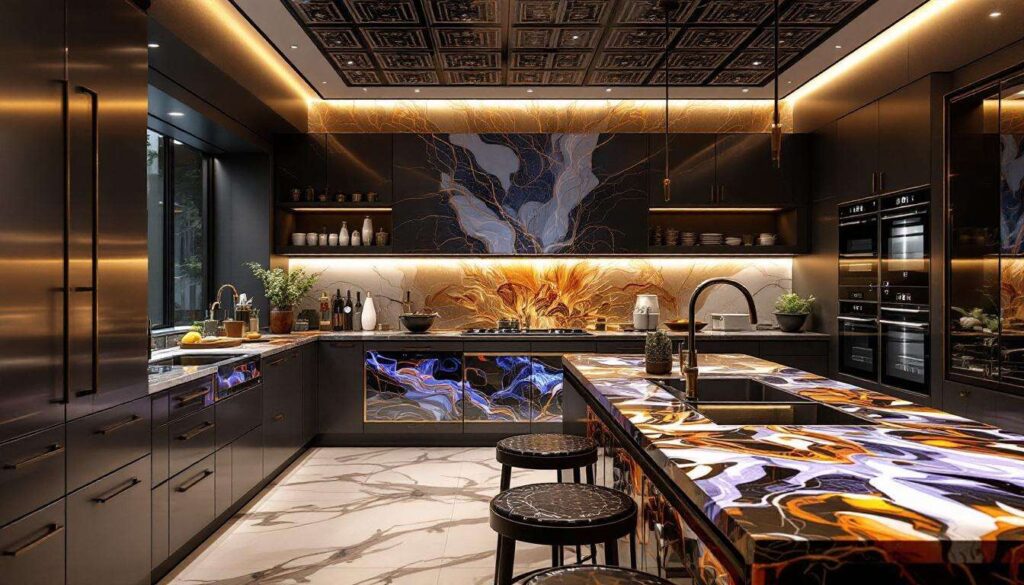
Rather than seeking uniformity, homeowners now celebrate the irregular patterns found in natural materials. Bold veining, mineral deposits and colour variations are no longer flaws to be minimised but features to be highlighted. This appreciation for organic imperfection represents a fundamental shift in design philosophy, one that values authenticity over manufactured perfection.
As these textured, patterned surfaces take centre stage, the colours that frame them have evolved to create cohesive, harmonious spaces.
Trending colours: soothing kitchen tones
Warm neutrals dominate the palette
The colour story of kitchen countertops has undergone a dramatic transformation. Cool greys and stark whites have been replaced by a warm, earthy palette that includes:
- Soft beiges and creamy ivories
- Warm taupes with grey undertones
- Gentle browns ranging from sand to caramel
- Muted terracottas and clay tones
- Warm whites with subtle golden or pink undertones
These colours create kitchens that feel nurturing and inviting rather than clinical. They pair beautifully with natural wood cabinetry, brass fixtures and organic textiles, contributing to a cohesive design narrative that prioritises comfort.
Rich, saturated hues make selective appearances
Whilst warm neutrals form the foundation, bolder homeowners are incorporating deeper, more saturated colours as accent pieces. Deep greens, navy blues and even black with warm undertones are appearing on kitchen islands and feature walls, creating visual anchors within otherwise neutral spaces.
These colour choices work in concert with innovative fabrication techniques that allow for seamless integration throughout the kitchen.
Innovation with continuous surfaces
Waterfall edges create visual drama
One of the most striking design innovations involves extending countertop material vertically to create waterfall edges. This technique, where the surface cascades down the side of an island or peninsula to the floor, creates a seamless, sculptural effect that transforms the countertop into a architectural feature.
Waterfall edges work particularly well with materials featuring dramatic veining, as the continuous pattern draws the eye downward and creates a sense of fluidity. This design choice eliminates visual breaks, contributing to a more cohesive aesthetic.
Integrated backsplashes eliminate seams
Designers are increasingly extending countertop materials up the wall to create seamless backsplashes. This approach offers several advantages:
- Eliminates grout lines that can harbour bacteria
- Creates visual continuity that makes spaces feel larger
- Showcases the full beauty of patterned materials
- Simplifies cleaning and maintenance
These continuous surfaces represent a marriage of form and function, proving that aesthetic innovation need not compromise practicality. As surfaces become more integrated, the overall layout of kitchen workspaces is also evolving.
Space optimisation with clever solutions
Kitchen spines replace traditional islands
The bulky kitchen island, long considered essential, is being reconsidered. In its place, elongated surfaces known as kitchen spines or peninsulas are gaining popularity. These slimmer configurations offer several benefits:
- Improved traffic flow through the kitchen
- More flexible spatial arrangements
- Better integration with open-plan living areas
- Enhanced social interaction during food preparation
Kitchen spines maintain the functional advantages of islands whilst creating a more open, breathable workspace. This design evolution reflects changing patterns of how families use their kitchens, prioritising movement and interaction over sheer surface area.
Secondary prep areas enhance functionality
To support the kitchen’s role as a social gathering space, many designs now incorporate secondary prep areas or butler’s pantries. These discrete zones allow hosts to manage food preparation and cleanup away from guests, maintaining the aesthetic appeal of the main kitchen whilst maximising practical functionality.
These clever spatial solutions ensure that beauty and utility coexist harmoniously, creating kitchens that genuinely serve as the heart of the home.
The kitchen countertop has evolved from a purely functional surface into a defining design element that sets the tone for the entire space. The movement away from minimalist aesthetics towards warmer, more textured materials reflects broader cultural shifts in how we inhabit and value our homes. Natural stones with rich veining, warm neutral palettes, tactile finishes and innovative fabrication techniques combine to create kitchens that feel both sophisticated and welcoming. As continuous surfaces and optimised layouts enhance both beauty and functionality, the kitchen truly becomes a space where design and daily life intersect seamlessly. This transformation represents not merely a stylistic shift but a fundamental reimagining of the kitchen as a place of connection, creativity and comfort.